
Youth Work Redefined
Investigating notions of employment and work for young people in Ethiopia.

Year: 2019
Location: Ethiopia
Partners: Jobs Creation Commission, Ethiopia, Mastercard Foundation.
Role: Senior Designer
Approach: HCD Research, Qualitative Research.
Team: Prerak Mehta, Jasper Grosskurth

Context
Ethiopia, like many developing countries, faces the challenge of youth unemployment and the associated issues of equity and limited growth opportunities within working environments. Traditional approaches to addressing youth unemployment relied largely on formal job creation, education, and technical skills. However, with a growing employment crisis, a growing youth population whose majority reside in rural areas and engage in rural work and casual labour, and rapid technological advances, a fundamentally new perspective on work and employment was required, one anchored in dignity and gainful work. In response to this, the Jobs Creation Commission (JCC) of Ethiopia commissioned this study to investigate and challenge the core notion of what employment and work mean for young people in the country.
Takeaways
1. For many young people, the pressure to provide for their families and communities is a heavy burden. Those who migrate to urban and peri-urban areas avoid returning home to escape the shame of being unable to provide, resulting in a total severance of both economic and social ties and a deeply isolated experience for young migrant workers. Addressing this requires a strategy that integrates psychosocial support and "dignity-first" employment services to prevent long-term social and economic disenfranchisement.
2. In very scarce resource settings, many young people dream of leaving their communities in search of better economic opportunities; however, these communities are often key to economic survival as young people rely on local trade, like supplying injera or local brewsupplying neighbours with injera, local brew to neighbours to meet their daily earnings. This points to a need for an employment strategy that formalizes and supports hyper-local, communal trade ecosystems rather than focusing exclusively on external, formal-sector job placement.
3. Urban, educated youth face a sharp disconnect. Grades dictate degrees, but degrees don’t guarantee jobs. We spoke to a generation of graduates trapped by highly specialised, non-transferable degrees like actuarial science—willing to pivot to new sectors like communications and marketing, but lacking the formal credentials to do so. Effective intervention requires a strategy that prioritises modular "bridge" certifications and skill-translation frameworks to unlock mobility for graduates trained in fields with lower workplace demand.


Research Objectives
This study sought to understand the human experience of the labour market for young people in Ethiopia. Our goal was to build a comprehensive picture of the youth employment landscape:
1. To understand the reasons for unemployment and the real and perceived barriers to finding dignified and gainful work in their life journeys
2. To identify drivers of existing income-generating activities
3. To map individuals’ journeys to identify the challenges, decision-points, fears, hopes, influence of surroundings and opportunities to find dignified and gainful work
4. To identify key demographic, psychometric and behavioural variables that influence young people's work and economic choices
Creative Explorations
We spoke to 62 people from urban, peri-urban and rural communities with a diverse mix of literacy and education levels and employment status across four regions in Ethiopia. The young people (median age 26 years) that we spoke to also had a mix of occupations, which included subsistence agriculture, casual labour, service sector, self-employed, office jobs, street vending, as well as a diversity in ethnicity.
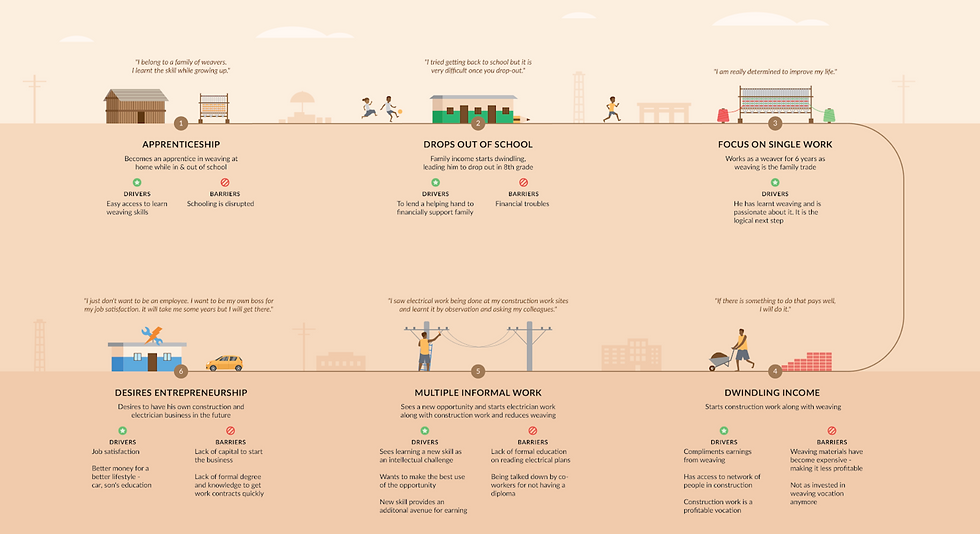
Our research toolkit utilised participatory activities—including interactive journey and ecosystem maps—to trace the work trajectories of young people and identify the key stakeholders in their environments. We integrated photo and video immersion as a creative tool to capture the nuanced qualitative details of these settings. These visuals were essential in documenting the stark geographic disparities in infrastructure and opportunity that define the different worlds young people live in, from dry pastoralist communities to fertile agricultural rural areas, to bustling, dense urban centres where high competition and infrastructure create a different set of survival pressures.
Highlights
In both urban and rural areas, multiple work opportunities were pursued to generate additional income sources to smooth earnings, as for most people, a single income source, like smallholder farming or casual daily wage labour or street vending, was volatile and too low to make ends meet.
Self-identity and pride in work were important, but for most young people, irregular work, low wages, and volatile income were common. Work was viewed as a means for survival to safeguard food, shelter and clothing for themselves and their families.
Despite the daily struggles, resilience and belief in self, supported by faith, provided people with the internal motivation to keep going. Even with a majority of young people engaged in the informal and casual labour workforce, many acknowledged education as the hope for children and youth to build a better life.
Outcomes
This work surfaced insights, emergent youth user profiles and actionable opportunity areas. The detailed insights were documented in the JCC’s State of Jobs 2019 Report, a comprehensive National Action Plan to address the unemployment crisis, which helped the Federal Commission influence policymakers and bureaucrats on matters concerning national unemployment in the country.


Take a look at some of the visual assets that we used to capture the insights on different experiences and journeys related to work, employment and livelihoods.



"
"I want to do an office-based job after finishing college, then slowly save and start a cafe on the side, earn a lot, then start a factory or any business and then enter into politics. I am inspired by studying civics as a subject in college and want to serve my people."
Quote from a 20 year old research participant on work aspiration
